Natural Structural Facial Rejuvenation Through Volume Restoration
Raggio MD Facial Plastic Surgery
Facial aging is not simply loose skin.
One of the most overlooked aspects of facial aging is gradual volume loss and structural deflation of the face. Over time, the cheeks flatten, the temples hollow, the jawline softens, and the skin loses support from beneath.
At Raggio MD Facial Plastic Surgery, Dr. Blake Raggio approaches facial rejuvenation structurally — not simply by tightening skin, but by restoring youthful facial support, contour, and harmony.
Autologous fat grafting uses a patient’s own purified fat, rich in regenerative stem-cell-rich components, to restore areas of facial volume loss naturally and subtly. When strategically combined with procedures such as the PreservaLift™ deep plane facelift, brow rejuvenation, eyelid rejuvenation, and structural necklift, facial fat grafting can help restore youthful facial architecture while maintaining natural facial identity.
The goal is not to make someone look fuller or different.
The goal is restoration.
Fat Grafting Expert In Birmingham, AL
What Is Facial Fat Grafting?
Facial fat grafting, also called fat transfer, is a procedure that uses a patient’s own fat to restore facial volume that has gradually diminished with age.
Fat is gently harvested from another area of the body, purified, and strategically transferred into specific areas of the face requiring structural support and rejuvenation.
Unlike synthetic fillers, autologous fat grafting uses living tissue from your own body. In addition to restoring volume, fat grafting may also improve skin quality and softness through regenerative stem-cell-rich properties naturally found within transferred fat.
Dr. Raggio utilizes facial fat grafting as part of a comprehensive approach to facial rejuvenation, focusing on:
- Structural restoration
- Facial harmony
- Natural contour
- Preservation of identity
- Long-term balance and support
Fat Grafting
5 stars over 300 reviews
Dr. Raggio is an exceptional plastic surgeon!
Why Facial Volume Loss Matters
Many patients believe facial aging is simply sagging skin, but aging also involves:
- Loss of deep facial fat compartments
- Descent of facial tissues
- Weakening of structural support
- Hollowing of the temples and cheeks
- Changes in facial contour and light reflection
- Deflation around the eyes and jawline
As facial support diminishes over time, the face can begin to appear tired, hollow, heavy, or less defined.
This is why simply tightening skin can sometimes create an unnatural appearance.
Modern facial rejuvenation often requires restoring volume in the appropriate anatomical locations to recreate youthful facial balance and support.
Dr. Raggio approaches facial fat grafting architecturally — carefully restoring contour where volume has been lost while preserving natural facial harmony.
Fat Grafting vs. Filler
Dermal fillers and facial fat grafting both restore volume, but they work very differently.
Dermal Fillers
- Temporary
- Synthetic products
- Useful for smaller refinements
- Require ongoing maintenance
- May contribute to overfilled appearance over time if repeatedly performed
Facial Fat Grafting
- Uses your own tissue
- Integrates naturally into facial structures
- Contains regenerative stem-cell-rich components
- Restores larger structural areas
- Often provides longer-lasting restoration
- Frequently complements surgical facial rejuvenation
Dr. Raggio frequently combines structural fat grafting with deep plane facelift surgery to restore youthful contour and facial balance in a natural, refined way.
The goal is not fullness.
The goal is restoring what time has gradually diminished.
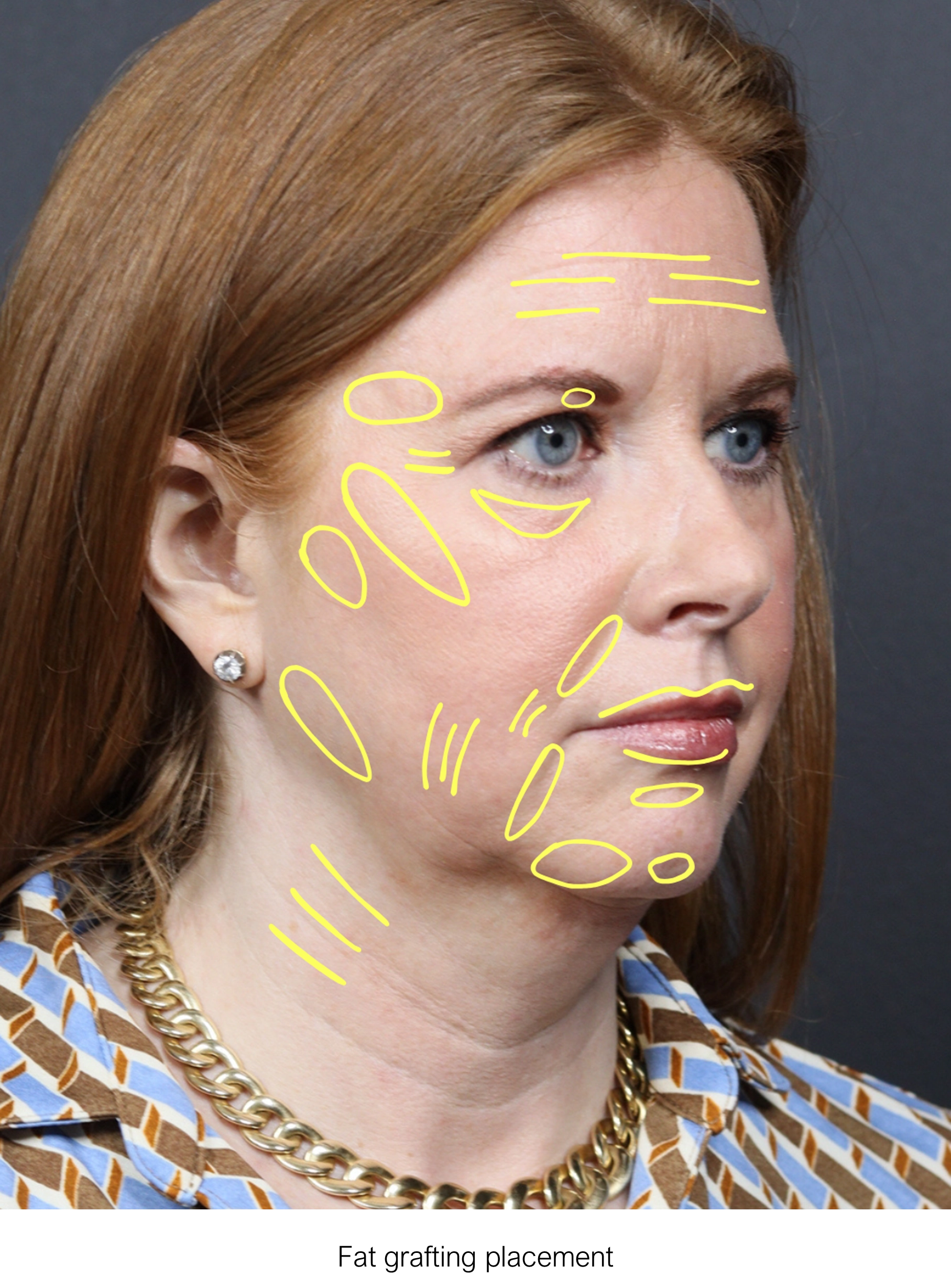
Areas Commonly Treated With Facial Fat Grafting
Temples
Temple hollowing is one of the earliest signs of facial volume loss. Restoring volume in this area helps recreate upper facial support and soften skeletal appearance.
Under Eyes / Tear Troughs
Volume loss beneath the eyes can create shadowing and a tired appearance. Strategic fat grafting may improve the transition between the lower eyelid and cheek.
Cheeks / Midface
As the cheeks flatten with age, the face loses youthful contour and support. Restoring midface volume can improve facial harmony and soften heaviness lower in the face.
Nasolabial Region
Volume loss and tissue descent contribute to deepening folds around the mouth. Structural restoration can soften transitions naturally.
Jawline / Prejowl Area
Loss of support along the jawline may create irregular contour and heaviness. Fat grafting can help restore continuity and smoother transitions.
Lips
Subtle lip enhancement using fat transfer may improve softness, hydration, and natural volume while maintaining facial balance.

A More Modern and Precise Approach to Fat Grafting
Facial fat grafting techniques have evolved significantly over time.
Traditional fat transfer methods often relied on larger-volume fat harvested during facelift surgery and transferred into limited facial areas such as the nasolabial folds or lips. While effective in certain settings, these approaches were often less refined and less customizable than modern structural fat grafting techniques.
Dr. Raggio instead utilizes a more modern structural fat grafting approach centered on:
- Autologous stem-cell-rich fat grafting
- Precise microcannula harvesting techniques
- Advanced fat processing
- Multiple fat particle sizes tailored to different anatomical areas
- Structural restoration guided by facial harmony and anatomy
This allows for:
- More precise placement
- Better contour refinement
- Restoration across multiple facial layers
- Improved integration into delicate facial structures
- Simultaneous focus on structure and skin quality
Rather than simply adding volume, Dr. Raggio approaches fat grafting as part of a comprehensive strategy of structural facial rejuvenation.
Why Fat Grafting Matters Structurally
Dr. Raggio views facial rejuvenation architecturally.
As facial tissues descend and deflate over time, restoring volume becomes essential to recreating youthful facial balance. Fat grafting is not simply about adding fullness — it is about restoring structural support and contour in precise anatomical locations.
When thoughtfully performed, structural fat grafting can:
- Restore youthful contour
- Improve facial harmony
- Soften harsh transitions
- Support facelift results
- Improve skin quality and softness
- Help maintain natural facial identity
Natural rejuvenation is not about changing the face.
It is about restoring balance and structure while preserving what makes a face uniquely yours.
Fat Grafting and Deep Plane Facelift Surgery
Facial aging is both descent and deflation.
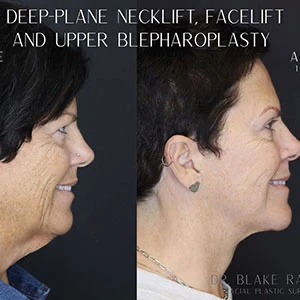
While a deep plane facelift restores structural position by repositioning descended tissues, fat grafting restores areas of volume loss that develop over time.
For many patients, the combination of a PreservaLift™ deep plane facelift with structural fat grafting creates a more complete and natural rejuvenation result.
This comprehensive approach may:
- Restore cheek support
- Improve jawline transitions
- Soften hollowing around the eyes
- Improve facial contour and balance
- Enhance overall facial harmony
The best facial rejuvenation results often come from restoring youthful structure rather than creating tension or excessive fullness.
Fat Grafting and Lower Eyelid Rejuvenation
One of the most important — and often overlooked — areas of facial aging occurs around the eyes and midface.
While excess skin and puffiness beneath the eyes are commonly associated with aging, volume loss and midface deflation also play a major role in creating:
- Hollowing beneath the eyes
- Dark shadows
- A tired appearance
- Flattening of the upper cheek
- Harsh transitions between the eyelid and cheek
Dr. Raggio frequently incorporates targeted structural fat grafting as part of comprehensive lower eyelid rejuvenation.
In many patients, he utilizes what he refers to as a lower eyelid rejuvenation “trifecta,” combining:
- Lower lid blepharoplasty
- Targeted midface and infraorbital fat grafting
- Skin resurfacing
This approach allows rejuvenation to address not only excess tissue, but also the underlying volume loss and skin quality changes that contribute to an aged appearance.
Targeted fat grafting beneath the eyes and through the midface often becomes the difference between a good result and a truly exceptional, natural rejuvenation result.
The goal is not simply to remove tissue beneath the eyes, but to restore youthful contour, softness, and transition between the lower eyelid and cheek.

Every Face Ages Differently
No two faces age the same way.
Some patients experience early volume loss in the cheeks and temples, while others develop hollowing beneath the eyes or along the jawline. Genetics, skin quality, anatomy, bone structure, and lifestyle all influence how the face changes over time.
Dr. Raggio performs a comprehensive facial analysis to determine:
- Where volume has been lost
- Which areas would benefit from restoration
- How to maintain facial harmony
- Whether fat grafting should be combined with other rejuvenation procedures
Every treatment plan is customized to the individual patient’s anatomy, goals, and natural facial structure.
Recovery After Facial Fat Grafting
Recovery after facial fat grafting varies depending on the extent of treatment and whether it is combined with other facial rejuvenation procedures.
Most patients experience temporary:
- Swelling
- Mild bruising
- Tenderness
- Temporary fullness during early healing
Transferred fat gradually settles as swelling improves over the following weeks and months.
Dr. Raggio and his team provide detailed postoperative guidance and personalized recovery planning to support optimal healing.
Beyond the Operating Room
At Raggio MD Facial Plastic Surgery, facial rejuvenation extends beyond the operating room.
For many surgical patients, postoperative care may include:
- Recovery hotel coordination
- Caregiver support
- Daily RN visits
- Hyperbaric oxygen therapy (HBOT)
- IV therapy
- Postoperative garments and supplies
- CO2 laser treatment to incision lines
- Botox to reduce tension in specific healing areas
The goal is to reduce stress and guesswork during recovery while optimizing healing and long-term results.
Contact us
Schedule your Fat Grafting consultation
Why Patients Choose Dr. Raggio for Facial Fat Grafting
Patients seeking facial rejuvenation often want to look refreshed — not different.
Dr. Blake Raggio specializes exclusively in facial plastic surgery and focuses on natural structural rejuvenation through:
- Deep plane facelift surgery
- Structural necklift techniques
- Stem-cell-rich facial fat grafting
- Brow rejuvenation
- Eyelid rejuvenation
- Facial harmony and preservation
His philosophy centers on restoring youthful structure while preserving natural identity, balance, and refinement.
The most successful facial rejuvenation results are often the least obvious.
To learn more about facial fat grafting and structural facial rejuvenation, schedule a consultation with Dr. Blake Raggio.
Raggio MD Facial Plastic Surgery serves patients throughout Birmingham, Mountain Brook, Vestavia Hills, Homewood, Hoover, and the Southeast seeking natural, sophisticated facial rejuvenation.