If you have been researching facial rejuvenation online, chances are you have seen the terms ponytail lift, scarless facelift, or endoscopic facelift everywhere lately.
It is easy to understand the appeal.
The language sounds modern. The marketing sounds elegant. The promise is subtle lifting, smaller incisions, and less visible scarring. But there is an important distinction patients deserve to understand:
A ponytail lift is not the best facelift for most people. In fact, it is usually only appropriate for a very small subset of patients, typically younger patients with minimal to no skin laxity and very early signs of descent. For the majority of people who are truly bothered by jowls, jawline blunting, or neck laxity, it often does not go far enough.
That is where surgical judgment matters.
As a facial plastic surgeon, my perspective is simple: the goal should never be to choose the most heavily marketed facelift. The goal should be to choose the right operation for your anatomy, your degree of aging, and the result you actually want.
For many patients, that means looking beyond the trend and understanding why a properly performed deep plane facelift remains the more complete, more powerful, and more reliable option.
What Is a Ponytail Lift?
A ponytail lift is generally used to describe a minimally invasive lifting procedure performed through incisions hidden within the hairline. In many cases, this overlaps with what people call an endoscopic facelift.
The basic idea is to elevate facial tissues upward toward the temples while avoiding traditional incisions placed around the ear. That concept sounds attractive on the surface. But the real question is not whether a technique sounds appealing. The real question is what that technique can and cannot actually fix.
A ponytail lift may offer improvement in carefully selected younger patients with very early descent. But it typically does not meaningfully address the problems that drive most people to seek facelift surgery in the first place:
- loose skin
- jowling
- heaviness along the jawline
- deeper folds
- neck laxity
- loss of youthful facial structure
That is the part many articles and social media clips gloss over.
What Is an Endoscopic Facelift?
An endoscopic facelift uses small incisions, often hidden in the hairline, along with a camera and specialized instruments to reposition tissue through a less extensive access pattern. Again, this can be useful in the right setting. But it is not a universal replacement for a traditional facelift. And it is certainly not the best option for the majority of patients seeking meaningful lower face and neck rejuvenation.
The main limitation is straightforward: if a patient has actual skin laxity, visible jowling, or an aging neck, an endoscopic or ponytail-style lift often does not fully correct those concerns because it is not designed to remove excess skin or comprehensively rejuvenate the jawline and neck.
Why Ponytail Lifts Are So Popular Right Now
This trend is not hard to explain. The ponytail lift has become popular because it sits at the intersection of three things patients naturally want:
- less downtime
- less visible scarring
- a result that feels subtle rather than overdone
Those are reasonable goals. The problem is that subtle should not mean insufficient. A procedure can be appealing in theory but underpowered in practice. That is where marketing and anatomy often diverge. Patients hear small incisions and assume better. But in surgery, smaller is not always better.
Better is better.
Ponytail Lift vs Deep Plane Facelift
A ponytail lift and a deep plane facelift are not interchangeable procedures. They are built for different problems.
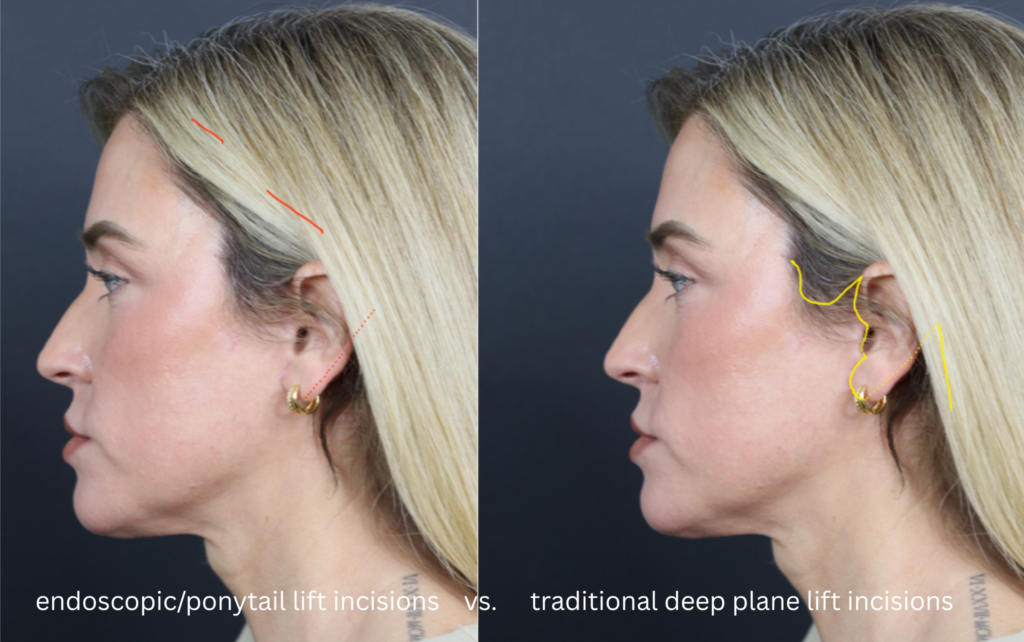
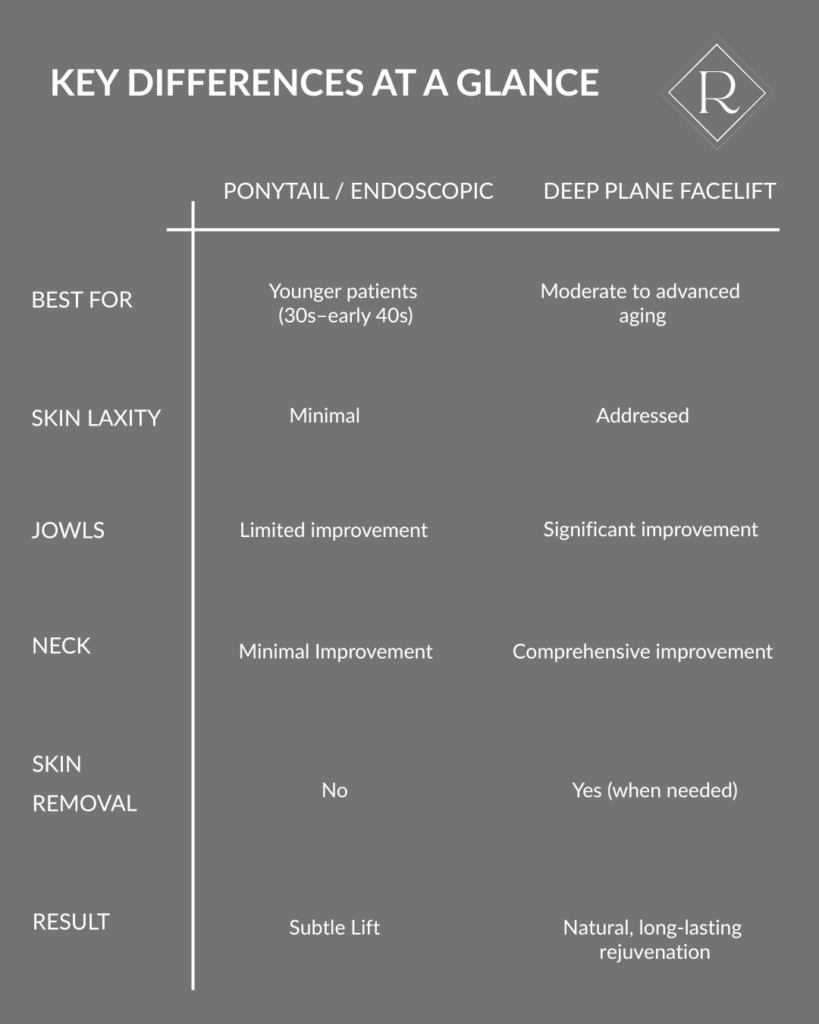
A ponytail lift generally aims to elevate tissue upward and create subtle improvement in select younger patients. A deep plane facelift, on the other hand, is designed to:
- reposition deeper structural layers
- improve the jawline and neck
- remove redundant skin when needed
- create more natural, longer-lasting rejuvenation
This difference is why outcomes—and patient satisfaction—can vary significantly
Who Is Actually a Good Candidate for a Ponytail Lift?
The ideal ponytail lift candidate is uncommon. Usually, this patient:
- is in their 30s or early 40s
- has minimal to no skin laxity
- has early descent rather than true aging changes
- does not need meaningful jawline correction
- does not need neck rejuvenation
That is a narrow group.Once visible jowls, looseness, or neck laxity develop, the limitations of a ponytail lift become much more obvious.
The Biggest Myth: “Scarless” Means Better
One of the biggest assumptions behind the ponytail lift is that avoiding incisions around the ear must automatically mean a better procedure. It sounds intuitive, but it is incomplete.
A well-performed facelift should not be judged by whether it uses periauricular incisions. It should be judged by how those incisions heal and how natural the result looks. In a properly executed deep plane facelift:
- incisions are placed along natural contours
- closure is tension-free
- suturing is meticulous and layered
In experienced hands, these incisions typically heal extremely well and are rarely the deciding factor for patients.
The result is.
Myth vs Reality
Myth: A ponytail lift is a better facelift because the scars are smaller.
Reality: Smaller incisions do not automatically mean a better result. The procedure still needs to address the patient’s anatomy effectively.
Myth: A ponytail lift can replace a deep plane facelift.
Reality: These are different procedures designed for different levels of aging.
Myth: If I want natural results, I should avoid a traditional facelift.
Reality: A modern deep plane facelift is specifically designed to create natural results by restoring structure, not pulling skin tight.
Myth: Incisions around the ear are usually obvious.
Reality: When performed properly, facelift incisions often heal very discreetly.
Myth: Less invasive always means better.
Reality: Less invasive only works if it still solves the problem.
Why Deep Plane Facelift Remains the Gold Standard
A deep plane facelift addresses facial aging more completely by working on deeper structural layers.
This allows for:
- natural repositioning of the face
- improved jawline definition
- smoother neck contour
- longer-lasting results
It is not about pulling tighter. It is about restoring anatomy.
Learn more about our signature approach, the PreservaLift™, which combines deep plane facelift techniques with advanced facial rejuvenation strategies.
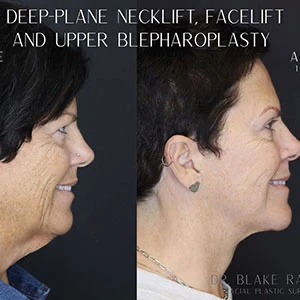
Before and After Photos Matter More Than Trend Names
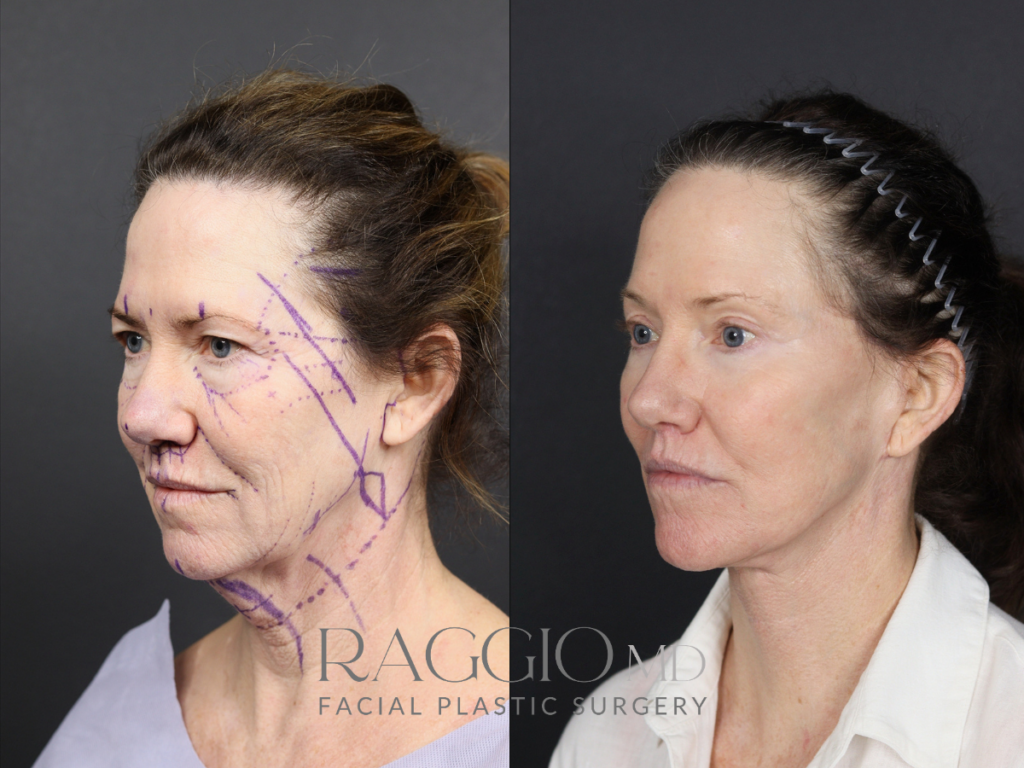
6 months post-op facial rejuvenation
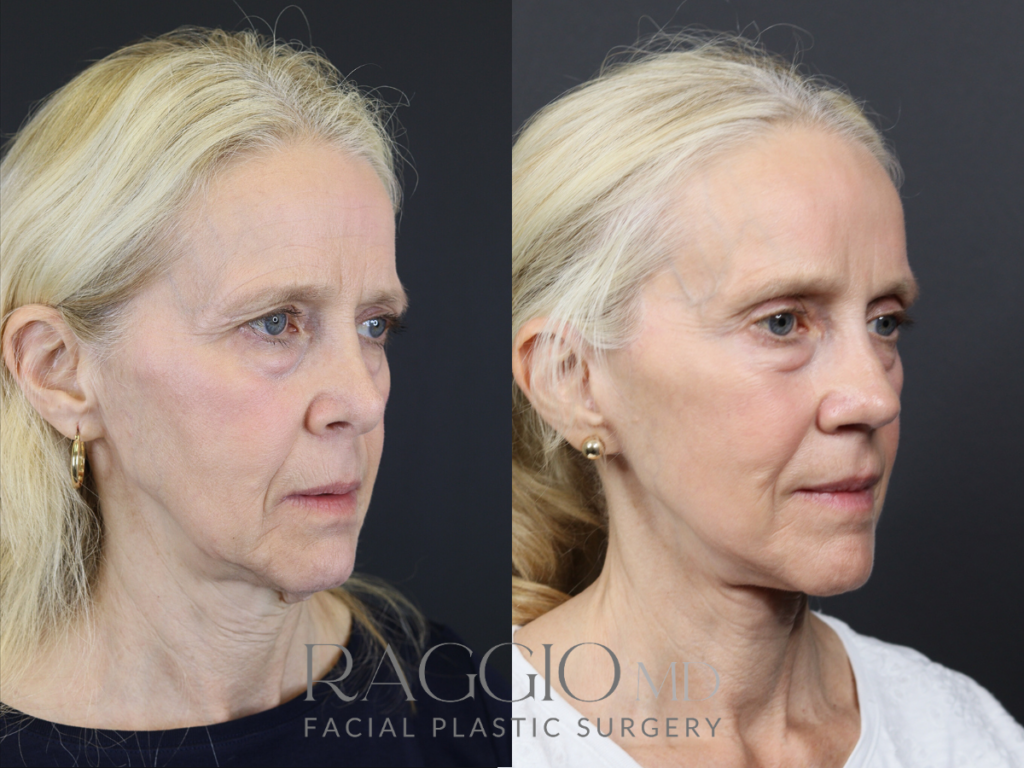
1 year post-op facial rejuvenation
If you are evaluating facelift options, spend less time focusing on branded terms and more time studying results.
Facelift Before and After photos and pay close attention to:
- jawline definition
- neck contour
- overall naturalness
- how the face moves and rests
The best facelift should never announce itself. It should simply look like a more youthful version of you.
A More Thoughtful Approach to Facial Rejuvenation
Choosing the right facelift is not about selecting the newest or most talked-about technique.
It is about matching the procedure to your anatomy, understanding the limitations of each option, and working with a surgeon who specializes in facial surgery.
The ponytail lift and endoscopic facelift are not inherently flawed procedures. They are simply limited procedures that are often applied too broadly. For a small group of younger patients, they may be appropriate. For most patients seeking meaningful, lasting rejuvenation, they are not the best solution.
Considering a Facelift?
If you are considering facial rejuvenation, the most important decision is not choosing the trendiest procedure.
It is choosing a facial plastic surgeon who understands when a limited lift is appropriate, when it is not, and how to create a result that looks natural both at rest and in motion.
The right procedure depends on your anatomy and goals and should be determined during a consultation with an experienced facial plastic surgeon.